


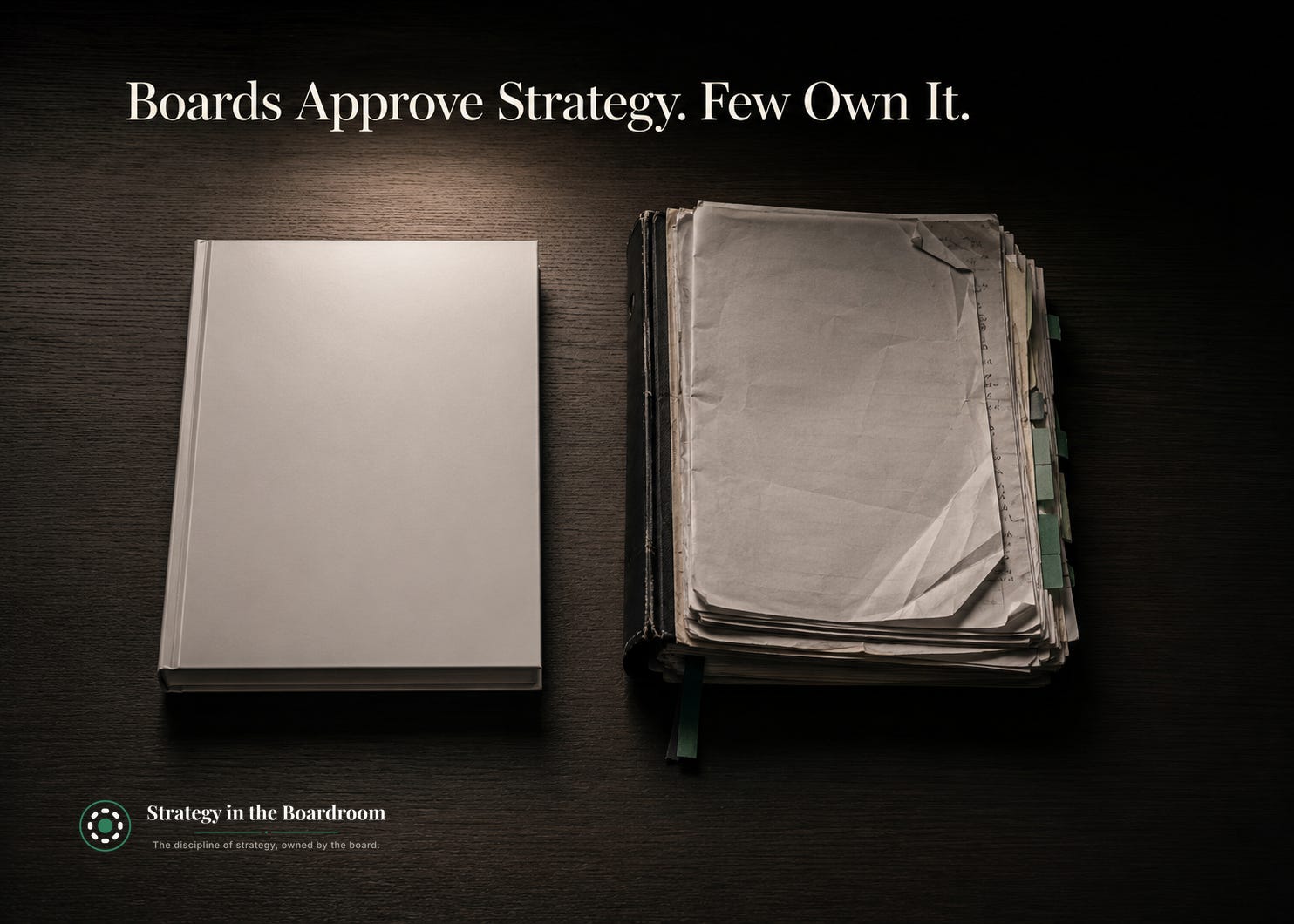
Picture the annual strategy away day. Management presents for most of the morning: market context, a bold ambition for 2030, five strategic pillars, and a transformation programme to deliver them. Directors probe the revenue assumptions, someone asks a question about competitors, the chair sums up the mood of the room, and by mid-afternoon, the strategy is approved. Everyone has done their job as the calendar defines it. Yet almost nothing that happened in that room tested whether the company has a strategy at all: a diagnosis of its situation, a theory of how it will win, and a set of choices that commit it to something. The board has ratified a document. Whether it owns a strategy is a different question, and the gap between the two is where a great deal of shareholder value quietly disappears.
Most strategy fails before anyone tries to execute it
Richard Rumelt spent his career examining why so much strategy comes to nothing, and his conclusion is uncomfortable for anyone who has sat through the away day described above. Most of what companies call strategy is nothing of the kind. A target (grow revenue by eight per cent, become the leader in our chosen markets) is an ambition, not a strategy. A genuine strategy requires an honest diagnosis of the situation the company faces, a guiding policy for dealing with it, and a set of coherent actions that reinforce one another. Most strategy documents that reach board tables contain the ambition and the actions but skip the diagnosis, because the diagnosis is the part that involves admitting something difficult: a structural cost disadvantage, a fading franchise, a competitor doing something better. When such plans fail, execution takes the blame, and the next planning cycle produces the same document with fresher language.
The UK has a recent and expensive illustration. Carillion’s strategy, as approved by its board year after year, was growth: acquisitions, expansion into new markets, and rising revenue, financed by mounting debt and stretched supplier payments, with a dividend that increased every year regardless of cash generation. Nothing in that plan explained why a contractor bidding for complex projects on wafer-thin margins would win profitably where rivals could not. There was no theory of advantage, only momentum. The company entered compulsory liquidation in January 2018, holding around £29 million in cash against roughly £7 billion in liabilities, including a pension deficit of £2.6 billion and some £2 billion owed to 30,000 suppliers. The joint parliamentary inquiry called the story one of “recklessness, hubris and greed”, and concluded that the non-executive directors had failed in precisely the duty this article is about: scrutinising and challenging the executives who drove the business. Carillion’s directors were not uniquely negligent. The machinery they operated is the machinery most boards operate today: receive the plan, question the numbers, approve.
The money doesn’t move
If a board wants to know whether its company has a real strategy, the evidence sits in the capital plan, not the strategy deck. McKinsey research covering more than 1,600 US companies over fifteen years found that for a third of businesses, the capital each unit received in a given year was almost exactly what it had received the year before: a correlation of 0.99. Across the whole sample, the mean was 0.92. All the strategic planning across those companies, all the away days, pillar frameworks, and transformation programmes produced barely any movement in where the money actually went. The cost of that inertia is measurable. Companies in the most active third of reallocators returned around ten per cent a year to shareholders, against six per cent for the most static. The gap compounds into roughly twice the company value over twenty years.
That finding should change how directors read every strategy paper put in front of them. If the strategy changes and the allocation of capital does not, the company has acquired a new document rather than a new direction. The budget is the real strategy; the deck is commentary on it. The test costs a board nothing to run: place this year’s strategy beside this year’s capital plan and last year’s, and ask management to explain the differences. In many companies, there will be almost none, and the conversation that follows will be the most strategic discussion the board has had in years.
Boards are built to ratify
Directors are not blind to any of this. As long ago as 2011, 44 per cent of directors in McKinsey’s global governance survey said their boards simply review and approve management’s proposed strategies. That finding is now fifteen years old, but the current view from the executive side suggests the posture persists: in PwC’s survey work, only 54 per cent of CEOs describe their directors as highly effective business partners in driving the company’s strategy. Half of the people bringing strategy to the board, in other words, do not regard the board as a serious contributor to it.
The cause is structural rather than personal, which is why capable and experienced directors keep producing the same result. The calendar concentrates strategy into one or two sessions a year, so the plan arrives fully formed, and the only realistic options are approval or a confrontation nobody wants. The information is curated by the team whose plan is under examination; the board sees the option management chose and almost never the options it rejected. And the norms of the boardroom make challenging the numbers feel like diligence, while challenging the underlying logic feels like a declaration of no confidence in the chief executive. Put a capable director inside that system, and the system wins. Ratification is what it was built to produce.
Ownership is a discipline, not a takeover
The objection arrives quickly, and it deserves a straight answer. Strategy is management’s job; a board that starts writing strategy has exceeded its role and has probably lost confidence in its CEO. Both points are correct, and neither touches the argument. Ownership does not mean authorship. The executive proposes strategy, and so they should: the market knowledge, the operational insight, and the accountability for delivery all sit with management. What the board owns is the process and the tests: the standard a strategy must meet before it earns approval, and the evidence that would show whether it is working afterwards. A board exercising that ownership asks for the diagnosis before the targets. It asks which alternatives were considered and why they were rejected. It asks what would have to be true for the plan to succeed, and how a named competitor is likely to respond. Above all, it asks whether the money follows the words, and it keeps asking between planning cycles, because advantage erodes on the competition’s calendar, not the company’s.
What stepping up looks like
None of this requires a governance review or a new committee; it requires the board to change what it demands. First, restructure the agenda so strategy is a standing discipline rather than an annual event: a quarterly deep dive on one strategic question beats a single away day that tries to cover everything. Second, change the information demand: require management to present the diagnosis and the discarded alternatives alongside the chosen plan, because a plan looks very different once you can see what it beat. Third, make capital reallocation a standing board measure (what proportion of capital moved this year, and whether the movement matches the stated intent) so the 0.92 problem is visible in the pack rather than buried in the budget. Fourth, test every major plan against a named competitor’s most damaging response, which is the question management teams are least likely to volunteer. Each of these is within any board’s existing authority. What they share is a shift in posture: from receiving strategy to setting the standard strategy must meet.
That is the discipline this publication exists to serve. Strategy in the Boardroom will take the elements of board-owned strategy in turn, from the theory of advantage and the capital test to the anatomy of effective challenge and the design of the strategy agenda, and give directors the questions and tests to run in the room. The tagline is also the argument: the discipline of strategy, owned by the board.
If this argument aligns with your experience at the board table, subscribe to Strategy in the Boardroom. I write for directors, chairs, executives, and advisers who believe strategy is a discipline the board must own, not a document it approves once a year. Each edition will focus on one element of that discipline and end with something you can use: a question, a test, or a demand to put to the next strategy paper that reaches you. The plans will keep arriving either way; the only question is the standard they have to meet when they do.