


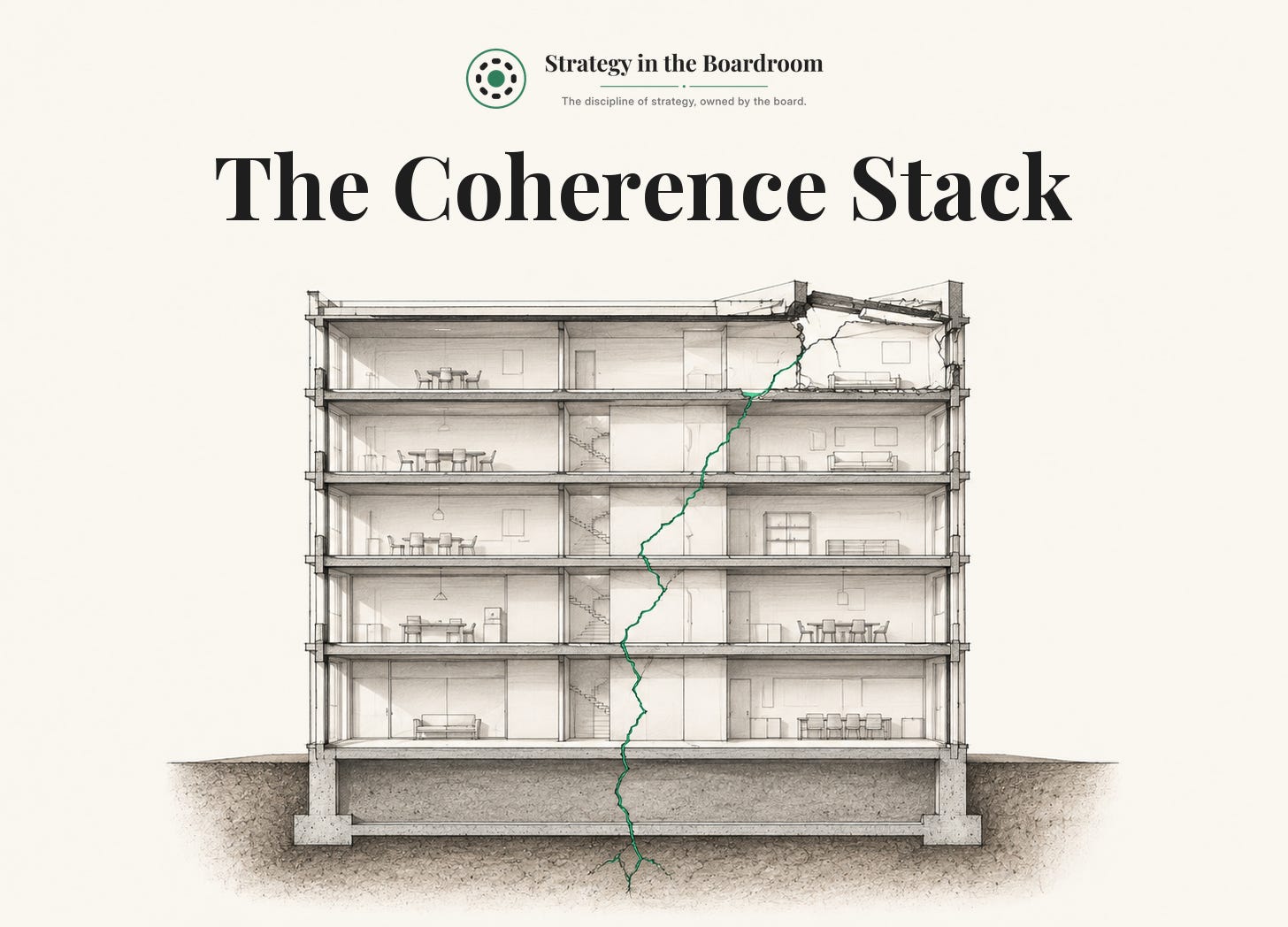
When strategy execution disappoints, the explanation offered is almost always a people problem: teams lacked capability, middle management lacked grip, the culture “wasn’t ready”. The more common cause is incoherence. The purpose says one thing, the strategy implies another, the structure preserves yesterday’s logic, incentives reward local optimisation, governance slows the work down, and teams are then blamed for poor execution. Each element may be defensible in isolation; together they cancel one another out. The Coherence Stack is a way of diagnosing this failure before it hardens into another transformation programme.
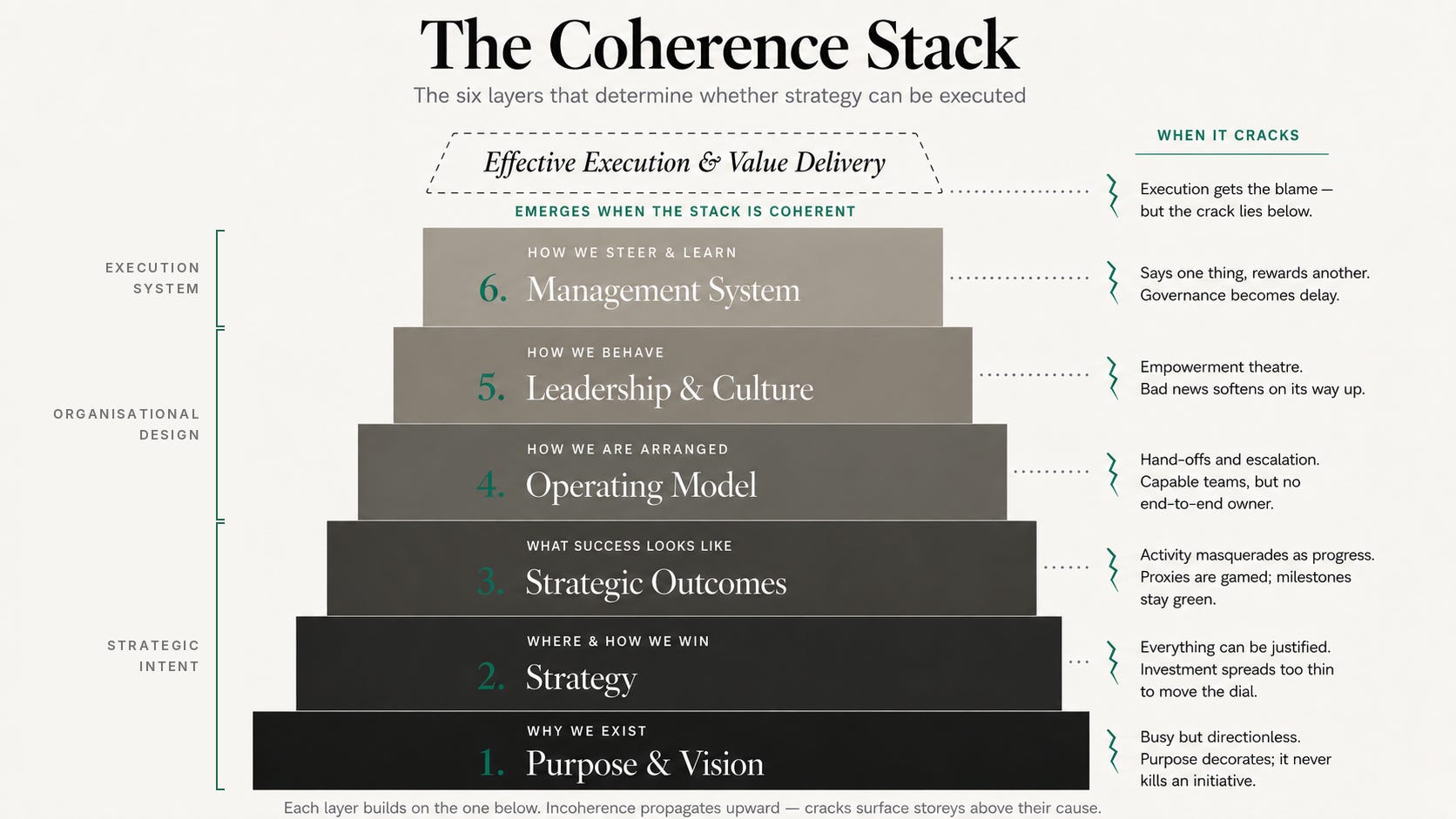
The model has six layers, built from the foundation upward. The first three form the foundations of strategic intent: purpose, strategy, and strategic outcomes. The next two form organisational design: the operating model and the leadership culture required to deliver the strategy. The final layer is the execution system: the management system that tells the organisation whether it is executing, learning, and improving. As with Maslow’s hierarchy of needs, each layer rests on the one below, which means weakness low in the stack cannot be compensated from above: a well-designed operating model cannot rescue a strategy that makes no choices, and a disciplined management system cannot save outcomes nobody has defined. Effective execution and value delivery sit at the top of the stack, but they are not a seventh layer, because leaders cannot build them directly. They emerge when the six layers leaders can shape are coherent.
1. Purpose & Vision
Purpose explains why the organisation exists. Vision describes the future it is trying to create. Together they form the foundation of the stack, giving strategic choices a moral and commercial anchor: they should shape where capital is allocated, which propositions are prioritised, how risk appetite is interpreted, and how value is judged. When this layer is weak, the organisation becomes busy but directionless. People may still work hard, but the work turns tactical and fragmented, and every function pursues its own version of what matters.
There is a subtler failure mode, common in organisations where purpose is strong and genuinely felt. Purpose becomes a source of pride and identity but is never translated into sharper choices, so it decorates the annual report while playing no part in capital allocation or prioritisation. In these organisations, the diagnostic question is not whether purpose exists, but whether anyone could point to a decision that would have gone differently without it.
2. Strategy
Strategy defines where the organisation will play and how it will win: its theory of competitive advantage. It turns purpose into choices: which customer needs matter most, which markets or propositions deserve investment, what capabilities must be distinctive, and what trade-offs the organisation is prepared to make. Without strategy, purpose remains aspiration.
When this layer is weak, everything can be justified. Modernisation, AI, efficiency, customer experience, capability building, and risk reduction all sound important, but there is no basis for choosing between them. Values-led and heavily regulated organisations are especially exposed here, because “doing the right thing” becomes a justification for doing too much at once, and no initiative wearing the badge of customer benefit or risk reduction can be declined. The result is excessive work in progress, slow decision-making, and investment spread so thinly that nothing moves the dial.
3. Strategic Outcomes
Strategic outcomes define what success looks like in measurable terms. They translate the strategy into a small set of outcomes that can be cascaded to business units, value streams, and teams; this is where objectives, KPIs, and OKRs belong. The critical test is whether the organisation can tell if the strategy is working, rather than whether activity is happening.
When this layer is weak, output masquerades as progress. Functions invent their own measures, programmes report delivery milestones, and governance tracks activity rather than value. A balanced set of outcomes guards against this. It should span the value delivered, the speed and flow of work, the quality of what is produced, the management of risk, and the experience of customers and employees. An organisation that measures only one of these will optimise it at the expense of the others: cost programmes that destroy customer experience, and delivery-date cultures that accumulate quality and risk debt, are both failures of outcome design before they are failures of execution.
4. Operating Model
The operating model defines how the organisation is arranged to deliver the strategic outcomes. It includes structure, decision rights, governance, funding, technology, data, capabilities, and enabling functions. Built on the foundations of strategic intent, this is the bridge between strategy and execution, and it is where many organisations make the wrong first move: they jump from strategy to an organisation chart, rather than asking how value needs to flow. A note on scope: many frameworks bundle into the operating model the steering routines this model deliberately separates, so the stack uses the term narrowly, with this layer holding the design and the management system at layer six holding the operation. The unbundling matters because a sound structure with a broken steering system, and a broken structure with sound steering, fail differently and are repaired differently.
Value streams should be the primary unit of strategy execution. A value stream is long-lived, multi-disciplinary, aligned to a value consumer, and focused on the flow from need to outcome. The test of a genuine value stream is whether improving that flow would directly improve customer, employee, risk, or commercial outcomes. This is not a claim that functional design is always wrong. Where work is stable and separable, and the competitive game is won on depth of expertise or economies of scale, organising by function is often the better and cheaper choice, and even committed value-stream organisations keep functional homes for scarce craft skills. The failure is the reflex: defaulting to the functional chart without pricing the hand-offs it creates, in an organisation whose advantage now depends on speed of learning and end-to-end customer outcomes. The symptoms of that mismatch are familiar in most large organisations: duplicated work, unclear ownership, slow decision-making, endless dependency management, functional incentives, and poor end-to-end accountability. The teams may be capable; the system makes good execution unnecessarily hard.
5. Leadership & Culture
Leadership and culture define how people actually behave inside the operating model. Leaders decide whether the model is lived or bypassed. They shape decision quality, psychological safety, accountability, curiosity, and the organisation’s appetite for intelligent failure. Culture is not what is written in the values statement; it is what the organisation repeatedly tolerates, rewards, and punishes. One objection is worth meeting directly: culture cannot be defined into existence, and the stack does not claim it can. What leaders define at this layer is the culture the strategy requires, modelled first in their own behaviour. The culture the organisation actually lives is emergent, produced by that example and by what the surrounding system tolerates, rewards, and punishes, much of which is administered by the management system in the layer above. That is why standalone culture programmes so rarely survive contact with an unchanged incentive system.
Even a well-designed operating model becomes theatre when this layer is weak. Leaders ask for empowerment but retain approval rights. They ask for experimentation but punish mistakes. They ask for pace but overload the system. The pattern in organisations that get this right is consistent: leaders change their own behaviour before demanding change from others, they create the safety required for people to surface problems early, and they treat strategy execution as emergent work to be steered rather than a deterministic plan to be enforced.
6. Management System
The management system defines how the organisation steers, learns, and improves. It includes planning, prioritisation, portfolio management, performance management, governance, risk controls, funding cycles, metrics, impediment management, and learning loops. Sitting at the top of the six layers, just beneath the value the stack exists to deliver, it is what tells leaders whether the intended outcomes are being achieved and whether the system itself is improving.
When this layer is weak, the organisation says one thing and rewards another. Measures become reporting burdens. Governance becomes a delay mechanism. Risk becomes a late-stage approval gate rather than a design partner. Portfolio management becomes a competition for resources rather than a system for maximising value. Organisations that fix this usually create a small, senior team whose job is to work on the system rather than in it: surfacing and removing organisational impediments, building capability, and spreading what works. That team only succeeds with genuine executive sponsorship; without it, the role decays into facilitating workshops while the impediments remain untouched.
The Apex: Effective Execution and Value Delivery
Team execution and value delivery are not layers for leadership to define. They are what the stack produces when the six layers beneath them are coherent. Leaders can set purpose, strategy, outcomes, operating model, cultural expectations, and management systems; they cannot decree effective execution. Execution emerges when the system enables teams to do valuable work with clarity, autonomy, feedback, and appropriate control.
This is the central diagnostic value of the model. When value delivery is poor, boards and executives tend to ask why teams are not executing. The better question is where the stack is cracked. The problem is rarely team capability. It is far more often unclear strategy, too many priorities, a functional operating model, leadership behaviour that contradicts the stated design, conflicting incentives, slow governance, or outcome measures that reward the wrong things. Like a crack in a foundation, the damage surfaces several storeys above its cause.
Six Questions That Locate the Crack
Each layer yields a question a board can ask in its next meeting without commissioning anything. On purpose: could anyone point to a decision that would have gone differently without it? On strategy: what have we explicitly chosen not to do? On strategic outcomes: could the board tell whether the strategy is working before the financial results arrive? On the operating model: is the organisation designed around the flow of value or around functions, and who owns each end-to-end outcome? On leadership and culture: where are we asking for empowerment while preserving control? On the management system: what does it make easy, and what does it make hard? None of these questions requires a programme or a consultant, and each one, honestly answered, tends to locate weakness with uncomfortable speed. They are the opening move of a diagnosis rather than the diagnosis itself, and a fuller instrument follows in the next edition.
The Board-Level Test
A board should not ask only, “Are we executing the strategy?” It should ask, “Is the organisation coherent enough to execute the strategy?” That question changes the conversation. It moves attention away from blaming teams and towards inspecting the stack that determines whether teams can deliver.
The model then becomes a practical diagnostic. If value delivery is weak, inspect the layers beneath it. If teams are overloaded, inspect strategic outcomes and portfolio management. If decisions are slow, inspect governance and decision rights. If transformation feels fragmented, inspect the operating model. If people wait for permission, inspect leadership behaviour and incentives. Execution problems are almost never repaired at the level where they appear. The work of strategy execution is the work of restoring coherence.
The Stack earns its keep when a board turns it on its own organisation, and that is where the next edition goes. Edition 6 introduces the Coherence Stack Diagnostic, a 36-statement instrument directors can put in front of the executive, and makes the case for reading the result by its weakest layer rather than its average. If this is the kind of board-level strategy analysis you want more of, subscribe to Strategy in the Boardroom. I write for directors, executives, and advisers who believe strategy is a discipline the board must own, not a deck it approves once a year.