

Most Board Challenge Is Performance, Not Testing
Edition 4: Why the questions boards ask protect the minutes rather than the plan, and what genuine testing requires.

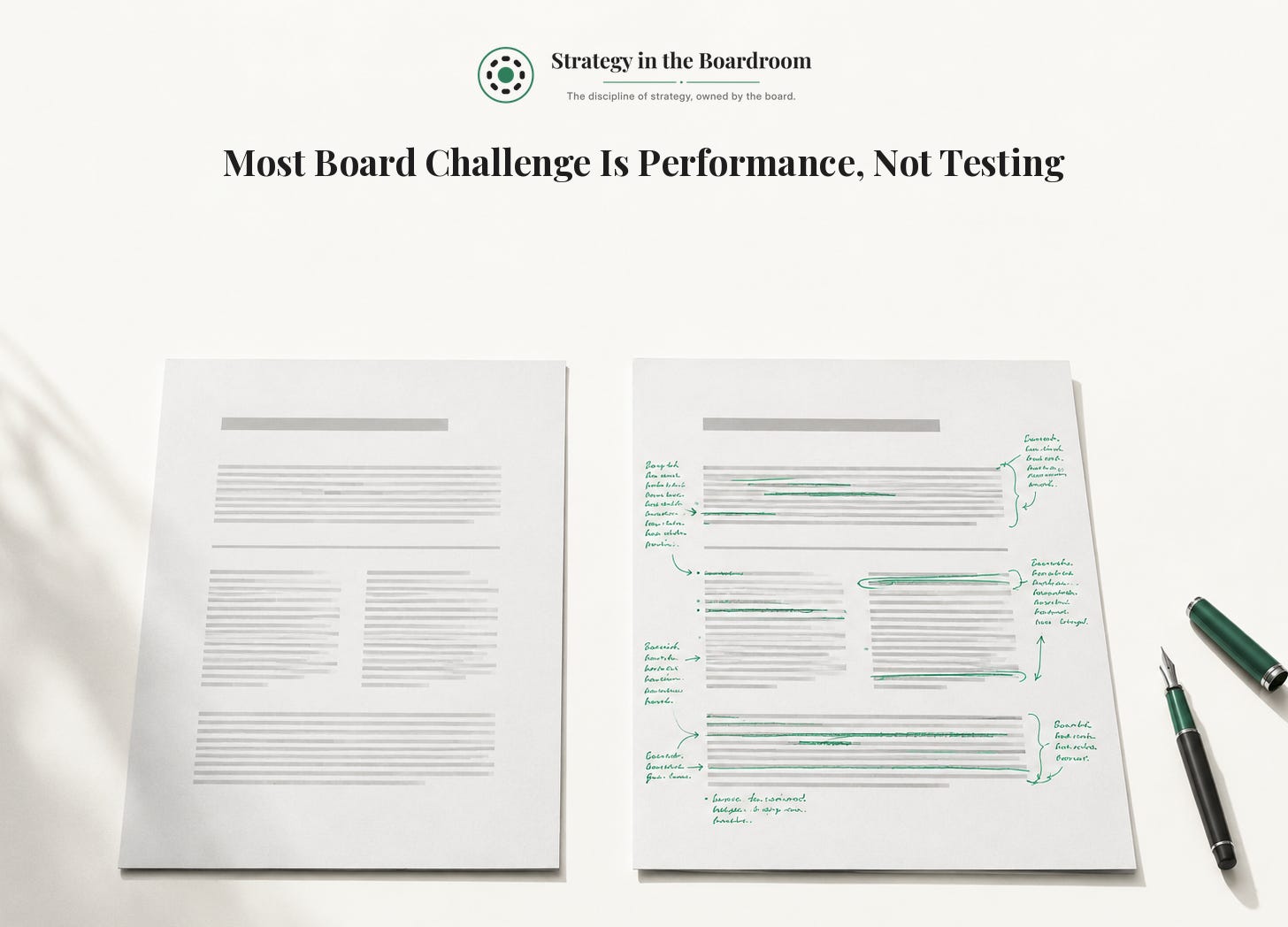
Picture the strategy session at any well-run board. The deck is immaculate, the executive team is well rehearsed, and the directors have done their reading. Questions come from around the table: about the China assumption, the margin bridge, the competitor response. The chief executive handles each one capably, and the room settles into the comfortable rhythm of diligence being done. The minutes will record robust discussion and appropriate challenge, because that is what everyone present believes took place. Now compare the plan that was approved with the plan that was presented. They are identical. No assumption was revised, no commitment narrowed, no option reopened, no condition attached.
That comparison is the most honest measure of board challenge, and many boards would fail it. Performance and testing are different activities with different outputs. Performance produces a record that diligence occurred: questions asked, concerns noted, scepticism visible to anyone who later reads the file. Testing produces revision: a changed assumption, a smaller first tranche, a claim withdrawn or narrowed, an approval made conditional on evidence. The first protects the board; the second protects the strategy. In Edition 1, I argued that many boards approve strategy without owning it, and promised an anatomy of challenge. This is it, and it begins with an uncomfortable observation: much of what passes for challenge in the boardroom is performed for the record, and the record is not the strategy.
The wreckage reads the same way every time
When companies fail, the subsequent inquiry rarely finds a silent board. It finds a board that asked questions but lacked intellectual curiosity. The FSA’s report into the failure of the Royal Bank of Scotland concluded that the bank’s collapse ultimately resulted from poor decisions by its management and board, and pointed to underlying deficiencies in governance and culture behind that pattern of decisions. The RBS board was not short of accomplished people or probing questions; it was short of questions with consequences, and the ABN AMRO acquisition proceeded on due diligence that no tested plan would have survived. The PRA and FCA reached the same verdict on HBOS in 2015: ultimate responsibility rested with the board and senior management, who failed to challenge a flawed business model built on continuous growth without regard to the risks. The model nobody tested went on to produce roughly £45 billion of impairment losses between 2008 and 2011, a loss rate of 10 per cent on the loan book. The report gives board composition and challenge to the executive its own section, which tells you where the investigators believed the failure began.
Carillion completes the set. The parliamentary inquiry found non-executive directors who, asked to show where their challenge had changed anything, could not. Three collapses, three inquiries, one finding: boards that performed scrutiny and tested nothing. The mechanism is worth naming, because performed challenge is more dangerous than silence. A silent board at least knows it has abdicated. A performing board holds minutes proving it did its job, which means the doubt that might have prompted real testing never takes hold. The performance inoculates the board against the suspicion that would have saved it.
Why boards perform: the plan arrives finished
Performance is not a character flaw. It is the predictable product of how strategy reaches the board. The plan arrives fully formed, after months of executive work, with the chief executive’s political capital committed and the top team aligned behind it. At that point, sustained challenge stops reading as a test of the plan and starts reading as a vote of no confidence in the person, so directors soften the question before it leaves their mouths. Information asymmetry compounds the problem: directors can probe only what management chose to present, with a fraction of the preparation time. And the incentives run one way, because the social cost of pressing hard in a collegial room is immediate and personal, while the benefit is deferred and invisible. PwC’s 2025 survey of corporate directors puts numbers on the discomfort: 55 per cent said at least one colleague on their board should be replaced, a record for the survey, yet the same research found that collegiality and unease with hard conversations stop boards acting on what they can plainly see. A board that cannot manage a hard conversation about its own composition will not volunteer one about the chief executive’s strategy.
There is a further mechanism, and designers identified it decades ago. In a study presented at CHI in 1996, Schumann and colleagues showed architects the same building design rendered two ways: as a rough sketch and as a polished CAD image. The sketch drew engagement, discussion, and suggestions for change; the polished render was treated as settled. Subsequent prototyping research has confirmed the pattern and the reason for it: polish signals that the work is finished and that significant effort has been invested, so reviewers hold back rather than devalue it, while rough work invites correction because correction still looks welcome. This is why experienced product teams test crude prototypes rather than finished ones. Now consider the strategy deck: sixty pages, professionally designed, rehearsed, and checked by bankers, the most polished prototype in corporate life. Its polish is doing work its logic should be doing. The document is engineered, deliberately or not, to make challenge feel like vandalism.
Timing sits underneath all of this. Once formation is complete, a board’s options collapse to three: accept, reject, or perform. Rejection is rare because it is close to a resignation matter for the executive, so performance becomes the residual choice. Alfred Sloan understood the trap at General Motors and is said to have adjourned meetings that reached agreement too easily, postponing the decision until genuine disagreement had been developed. He grasped that consensus arriving on schedule is usually consensus that was never tested.
Testing has a structure
The alternative to performance is not aggression. It is structure, and the structure has three parts. The first discipline is to aim challenge at the logic rather than the judgement. In Edition 2, I gave boards a shared instrument for this: a strategy must show a choice, a source of advantage, an erosion analysis, and a prediction that ends in a number. A board that adopts tests of this kind converts challenge from a personal duel into the application of a discipline. “Convince me this will work” attacks the executive and invites defence; “run the erosion test on this advantage” applies an instrument the whole board has agreed to, and invites evidence. The chief executive can lose an argument with a framework without losing standing, which is what makes honest answers affordable.
The second discipline is to move challenge upstream, into formation, where the design research says it belongs. Ask to see options rather than an answer: the strategies considered and rejected, and the reasoning that eliminated them. Use devices that license dissent by design. Gary Klein’s pre-mortem is the cleanest example: before approval, the board assumes the strategy has failed three years out and writes the story of why, which converts doubt from an act of disloyalty into an assignment. Rotating an assigned challenge role does similar work by moving the social cost of scepticism onto the structure rather than the sceptic. Most usefully of all, separate the testing session from the approval session, because a board asked to test and approve in the same hour will approve, and call the first forty minutes testing.
The third discipline concerns the question itself, because testing questions have an anatomy. A testing question forces a choice, exposes a dependency, or demands a claim that could prove false. A performing question requests reassurance, and reassurance is always supplied. “Are we confident in the growth number?” will be answered yes at every board, every time. “Which assumptions around growth would you commit to in the incentive plan, and which would you drop first?” forces a ranking that reveals the executive’s own confidence. “Have we considered the competitor response?” performs; “what would our largest rival need to do to make this plan value-destructive, and what would we see first?” tests. The difference is mechanical rather than rhetorical: the performing version can be answered with a word, while the testing version can only be answered with content, and content is what the board is there to examine.
The evidence of challenge is revision
The practical implications fall mainly to the chair, because challenge that depends on individual courage will lose to the room every time; it has to be designed. Sequence the strategy calendar so testing precedes approval by at least one cycle. Commission the alternative case rather than waiting for a volunteer. And track the one metric that cannot be performed: the revision record, meaning what changed between the strategy as presented and the strategy as approved. Minute the delta, not the atmosphere. A strategy that passes through the board wholly unchanged was either exceptional or untested, and the board should be able to say, in terms it would repeat to an inquiry, which of the two it was.
Directors should be clear about what declining to test actually is. It feels like the safe option: the relationship preserved, the meeting on time, unanimity in the minutes. It is a dereliction of the role. The Companies Act requires a director to exercise independent judgement and bring reasonable care, skill, and diligence to the task. A director who withholds the testing question has exercised neither; they have transferred an unexamined risk to shareholders and kept the comfort for themselves. The directors of RBS, HBOS, and Carillion discovered that the risk eventually finds its way back, and that “the atmosphere in the boardroom was collegial” is not a sentence any inquiry has ever accepted in mitigation. Comfort is not a defence.
To return to the well-run board where this piece began, and to the plan approved exactly as presented. The right response is not embarrassment but a question the board should be able to answer: why did nothing need to change? Sometimes there is a good answer. A board that owns strategy, rather than approving it, knows the difference, because it has the revision record to show for it. Challenge is also only one of the mechanisms through which a board’s intent is transmitted into the organisation or quietly lost on the way, and next week’s edition examines that system as a whole.
If this is the kind of analysis you want arriving before your next strategy session, subscribe to Strategy in the Boardroom. I write for directors, executives, and advisers who believe challenge is a discipline the board designs, not an atmosphere it hopes for. Future editions will keep working through the questions of advantage, capital, and oversight that boards cannot afford to take on trust.