


The budget was approved in October. The strategy arrived in November as a sixty-page deck, with a recommendation on the last page and a vote scheduled for the same afternoon, and the away-day in September had presented the same material at an earlier stage of polish. Nobody in that sequence behaved badly: the chair ran a fair meeting, the executive did a great deal of work, and the board discharged every item the calendar put in front of it. What the calendar did not put in front of it was a choice. By the time the board saw the strategy, the money that would fund it had been allocated, the options that lost to it had been discarded, and the diagnosis beneath it had been settled by the people whose plan depended on it. Edition 1 argued that boards approve strategy and rarely own it. The reason that is hardest to see from inside the room is the order in which the work arrives.
Get the diagnosis wrong and nothing downstream can be right
Richard Rumelt’s kernel of a strategy has three parts: a diagnosis that identifies which aspects of the situation are critical, a guiding policy for dealing with them, and a set of coherent actions that carry the policy out. He counts mistaking goals for strategy among the hallmarks of bad strategy, and a plan that opens with a revenue ambition and closes with a list of initiatives is the form that mistake usually takes. In my experience, most strategy papers that reach a board contain the ambition and the actions and skip the diagnosis, or bury it in a market-context section that nobody is asked to review. The omission is rarely careless. A diagnosis names the single problem that matters most, or the single opportunity worth the capital, and naming it means admitting a cost disadvantage, a product that has stopped growing, or a competitor doing something better. The guiding policy and actions follow from whichever problem the diagnosis picks, so a board that has not tested the diagnosis has not tested anything. It has reviewed a set of actions against a problem it did not choose and may not have noticed.
Carillion is the case the archive keeps returning to, and it belongs here as the clearest example of a strategy with no diagnosis in it. The joint committee inquiry found that its acquisitions lacked a coherent strategy beyond removing competitors from the market, and that its non-executives failed to scrutinise or challenge the executives running it. A contractor bidding for complex work on thin margins had one critical question, which was whether it could win profitably where its rivals could not, and the plans its board approved answered a different one, which was how fast it could grow. Growth was the ambition and acquisitions were the actions; the problem they were meant to solve does not appear in the plans. By January 2018 the company held £29 million in cash against liabilities of nearly £7 billion, including a pension liability of around £2.6 billion and around £2 billion owed to its 30,000 suppliers, sub-contractors, and other short-term creditors, and the inquiry called it “a story of recklessness, hubris and greed”. A board asked to agree the diagnosis before it saw the plan would have had to say what business Carillion was in and why it would earn a return there, and that is the question its approvals never reached.
Management analyses; the board sequences
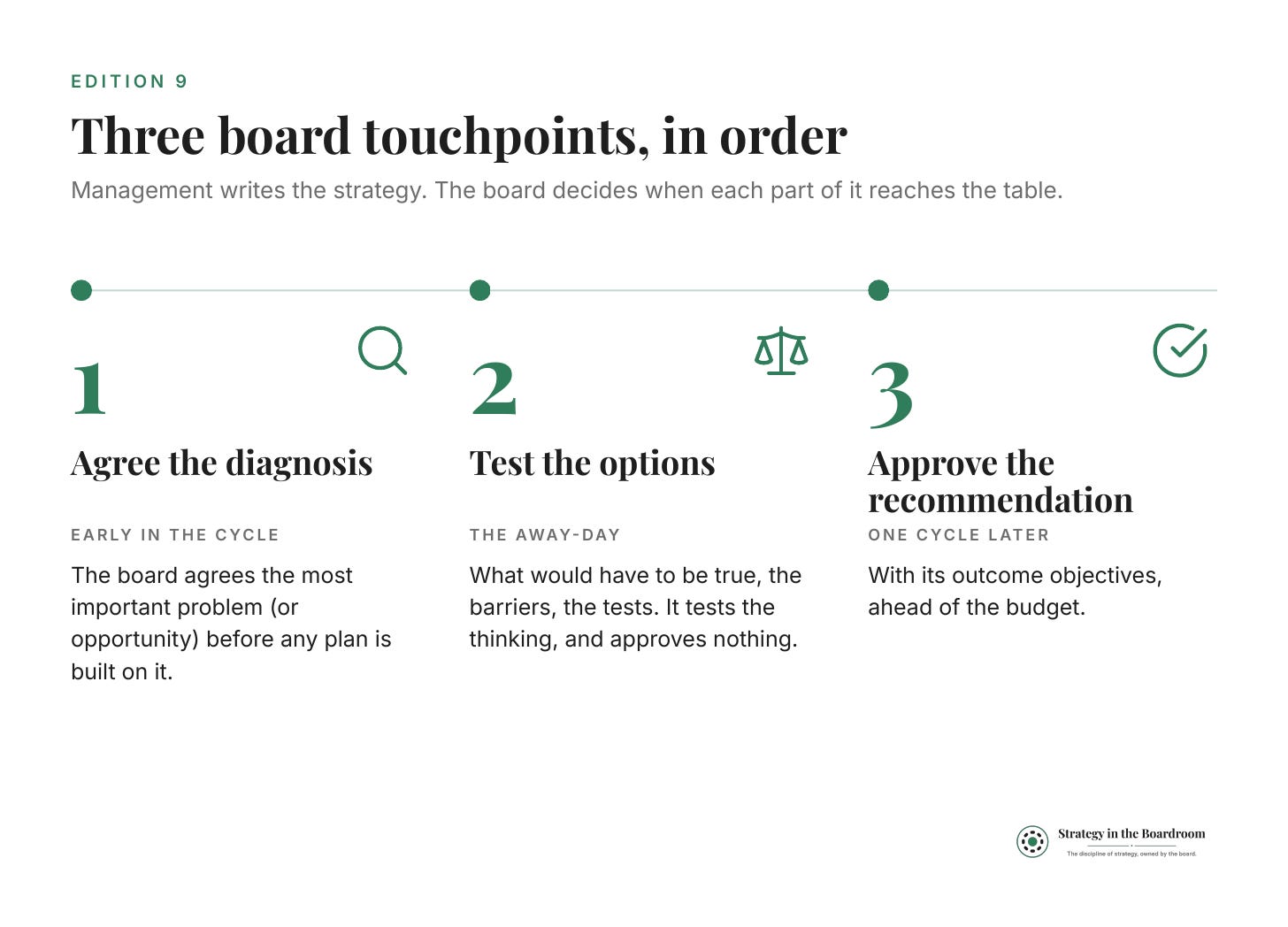
None of this is an argument for directors doing the analysis. The executive performs the strategic analysis, writes the diagnosis, generates the options, and brings a recommendation, and it should, because the market knowledge, the operating data, and the accountability for delivery all sit with management. What the board owns is the order in which those things reach the table and the evidence each must carry when it arrives. Roger Martin, who has spent years on both sides of these meetings, describes a common verdict from board members: management did high-quality work, on the wrong issues. His remedy is three interactions across the cycle in place of one day, which is the right shape. The board agrees the biggest problem to be solved at the start, reviews the possibilities and the conditions each depends on in the middle, and approves a recommendation at the end. The division of labour that makes this work is the one Edition 1 set out: the board owns the standard and the process; management is the author.
That sequence does something a single approval meeting cannot. It separates the three parts of the kernel into three decisions and places each where the board can still change it. A diagnosis agreed in the spring is cheap to amend, because nobody has built a plan on it. The same diagnosis challenged in November, with a sixty-page deck resting on it, has a price the room can feel even if nobody states it: the planning team’s months of work, the business cases already written against the chosen option, the capital already pencilled into the budget on the strength of it, and the chair’s relationship with a chief executive who has just been told that the premise was wrong. Few boards pay that price, so the diagnosis stands by default. Edition 4 argued for separating the session that tests a strategy from the session that approves it. Extending the same principle across the year is this edition’s whole argument. Testing produces revision only when there is still time and room to revise, and the calendar decides whether there is.
If the budget comes first, the strategy is commentary
The budget is where this goes wrong most often. In many listed companies, the budget is approved shortly before the financial year begins, on a cycle run by finance, and the strategy is approved on a cycle of its own, usually near the same date and sometimes after it. When the budget closes first, the strategy that follows can only describe spending already committed. A survey of 156 large companies by Mankins and Steele found that at two-thirds of them, planning was a periodic event, often run as a precursor to the yearly budget and capital-approval process, and the authors observed that in most companies the two were not explicitly linked at all. McKinsey’s reallocation research on more than 1,600 US companies over fifteen years found that, for a third of them, each unit received almost exactly the same capital each year as the year before, a correlation of 0.99, with a mean of 0.92 across all industries: allocations barely move from year to year, whatever the strategy says. Edition 1 read that as evidence that strategy rarely moves money. Put beside the planning survey, the two findings describe a budget that closes before the strategy can move it.
The rule that follows is a scheduling rule, and it needs no new committee. The strategy decision precedes the budget by at least one cycle, and the budget paper that follows shows the deltas the strategy required: which lines grew, which shrank, and which stopped. A board can test compliance in a single question, put to the chief financial officer with the budget in front of it: where in this budget is the strategy we approved? Where the answer is a reconciliation, the sequence is working. Where the answer is that the strategy will be reflected in next year’s numbers, the board has approved a document and funded a different one. The Code’s guidance asks the chair to set an agenda focused primarily on strategy and says nothing about when the strategy sits relative to the budget, which leaves the sequence entirely in the chair’s gift.
Options arrive with the objectives that will prove them
Martin’s middle meeting, the one where management brings the possibilities and what would have to be true for each, needs one addition that the strategy literature tends to leave to the planners. Every option presented to the board carries, besides its conditions for success, the two or three outcome objectives the board would monitor to know whether those conditions are holding once the money is spent. An option without them is a preference, and a board that approves a preference has nothing to check against six months later. The objectives do the work the diagnosis started: if the critical problem is cost, the objective is a margin; if it is a product losing share, the objective is the share. This is where Edition 7‘s change dashboard is drawn from, and it is why the measurement editions and this one are the same argument. The board approves a strategy and the evidence of its success in the same minute, and the objectives graduate from the strategy paper to the pack without a second decision being needed.
Keep the away-day; change its job
Martin advises eliminating the board strategy day, and the diagnosis is correct: a single day held after management has finished thinking sets both sides up to be disappointed. The board nitpicks a finished plan; the executive, having spent weeks on it, hears every question as a verdict. The day is a fixture of most board calendars I have seen, and the posture it produces is the one McKinsey recorded in 2011, when 44 per cent of some 1,600 directors said their boards simply review and approve management’s proposed strategy. Nothing I have seen since suggests the posture has changed, and the format produces it.
I would keep the day and give it a different job. The away-day is the meeting where the board tests the options against a diagnosis it has already agreed, and approves nothing. Management brings the two or three possibilities it is weighing against that diagnosis, what would have to be true for each, and the conditions it is least sure of. The day ends with a shortlist, the tests management will run before the next meeting, and a minute recording which possibilities the board has set aside and why. The vote comes a cycle later, at an ordinary board meeting, on a recommendation the board has already shaped. The rule I would ask any board to adopt first is a single line: nothing is approved at the meeting where it is first tested. A board that keeps that rule solves the away-day problem without losing the one day a year its directors spend together on the company’s future.
The strategy year on a page
Put together, the sequence gives each meeting of the year one strategic job. Early in the cycle, the board reads the external scan and agrees the diagnosis. The away-day tests the options against their conditions and sets the tests. A later meeting receives the test results and the recommendation, and approves the strategy and its objectives. The following budget meeting moves capital to match it. The portfolio review and the risk appetite statement have their own slots, so stopping things and setting limits become decisions the board makes on a date. The review runs as a standing quarterly item, where the board asks whether the objectives it approved are moving, and Edition 7’s dashboard does the work. For a December year-end, that is a diagnosis in March, an away-day in June, approval in September, the budget in November, and reviews in between. In McKinsey’s survey of nearly 800 executives at large companies, only 23 per cent said they made major strategic decisions inside the planning process. A calendar built this way is an attempt to put them back.
A board that cannot rebuild its whole year at once should know which failure to fix first, and I would rank the three differently from the kernel’s order. The budget closing before the strategy is the costliest failure, because it is the only one that cannot be undone within the year: once the capital is committed, every later strategic decision is a decision about next year, and a budget that rolls forward almost unchanged, which is what the McKinsey correlation describes, is the result of that happening for a decade. Fix that first, by moving the strategy decision ahead of the budget, and the board has recovered its one irreversible lever even if nothing else changes. Second comes the diagnosis settled by its own authors, which is the failure that does the most damage when it strikes, since every option and every objective inherits its error, but which a board can still catch late at a cost, as the November challenge shows. Third is the discarding of options before the board sees them, which is the most common of the three and the cheapest to repair, because it is fixed by the single demand Edition 1 made for the alternatives in the pack, now with their conditions attached, and a board that has fixed the first two will usually find the third has fixed itself.
What to minute at the next meeting
Three decisions fall within any board’s existing authority, and the board can minute them in one meeting. The board adopts the strategy year as a one-page calendar in which each meeting has a named strategic job, and gives the chair and the company secretary ownership of it. It sets two sequencing rules: that approval lags testing by a cycle and that the budget follows approval, with the budget rule applied first if only one can be applied this year. And it requires every option in a strategy paper to include its conditions for success and the objectives that will show whether they are holding. A board that makes these three decisions has left the crafting of strategy with its executive, and changed the order in which the strategy reaches it. It is that order that has been quietly handing the decision to management all along.
If this is the kind of board-level strategy analysis you want more of, subscribe to Strategy in the Boardroom. I write for directors, executives, and advisers who believe strategy is a discipline the board must own, not a deck it approves once a year. This edition closes the promise Edition 1 made about the strategy agenda; the next takes the first slot on that calendar, the external scan, and asks what a board should actually be watching before it reads the plan.